Standing Explosion (Red)
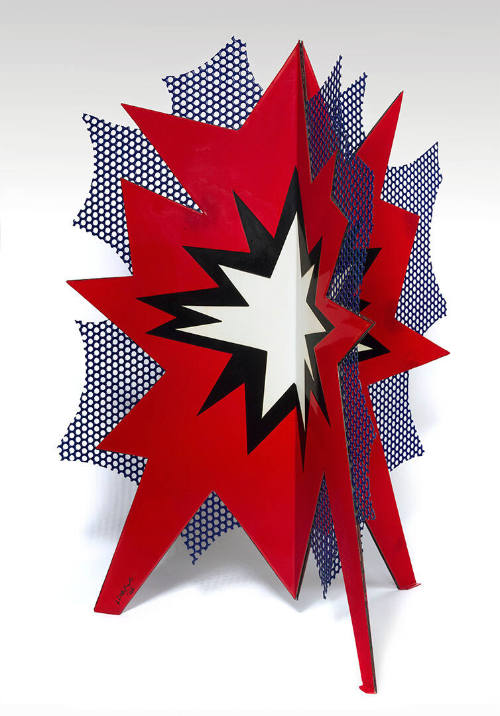



Standing Explosion (Red)
Artist
Roy Lichtenstein
(1923 - 1997)
Date1965
MediumPorcelain enamel on steel
Dimensions38 x 25 x 30 in. (96.5 x 63.5 x 76.2 cm)
ClassificationsSculpture
Credit LineCrystal Bridges Museum of American Art, Bentonville, Arkansas, 2010.8
Signedon leg, in black paint: Lichtenstein / 66
Accession number
2010.8
On View
Not on viewLabel TextBANG! WHAM! POP! The angular outline of this sculpture derives from the shapes of explosions in comic books. Roy Lichtenstein drew heavily from comic book images in his paintings and sculptures of the 1960s and 70s. Like his paintings and their comic book sources, Standing Explosion (Red) uses bold primary colors and heavy outlines. The perforated sheets of steel mimic the look of Benday dots—the technique used to print images in comics.
Like his contemporaries Andy Warhol and Tom Wesselman, whose works appear nearby, Lichtenstein was interested in how images from pop culture shape a shared American consciousness. Their art emerged in an era increasingly dominated by the rise of television and advertising, and came to be known as Pop Art.
Pop artists like Roy Lichtenstein drew inspiration from images encountered every day in mass media and advertising, incorporating bold colors and thick outlines into their own visual languages. Lichtenstein’s signature use of Ben Day dots, commonly found in comic books, can be seen in the perforated steel of his sculpture. Despite the small selection of colors and simple shapes, Standing Explosion still manages to capture the outward and dynamic energy of a cartoon explosion.
Los artistas pop como Roy Lichtenstein se inspiraron en imágenes que veían a diario en los medios de comunicación y la publicidad, incorporando colores vivos y contornos gruesos a su propio lenguaje visual. El característico uso que Lichtenstein hacía de los puntos Ben Day, que suelen aparecer en los cómics, se puede apreciar en el acero perforado de su escultura. A pesar de la reducida selección de colores y las formas sencillas, Explosión de pie consigue capturar la energía exterior y dinámica de una explosión de dibujos animados.