Shipbuilding #1
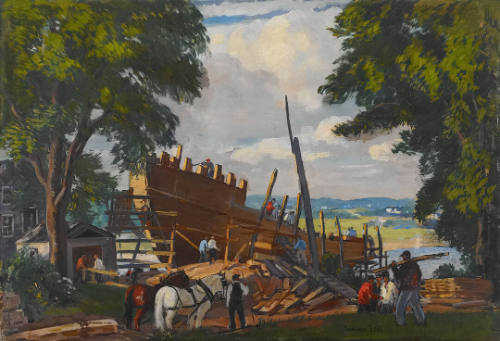
Shipbuilding #1
Artist
Gifford Reynolds Beal
(1879 - 1956)
Dateca. 1940
MediumOil on board
Dimensions33 × 48 in. (83.8 × 121.9 cm)
Framed: 40 in. × 54 7/8 in. × 2 3/4 in.
Framed: 40 in. × 54 7/8 in. × 2 3/4 in.
ClassificationsPainting
Credit LineCrystal Bridges Museum of American Art, Bentonville, Arkansas, Gift of the Estate of Gifford Beal, courtesy of Kraushaar Galleries, New York, 2008.21
Signedl.r., in black paint: Gifford Beal
Accession number
2008.21
On View
On viewLabel TextBorn in a family of artists, Gifford Beal looked back to early impressionism and incorporated heavy outlines and bright areas of color into his painting.
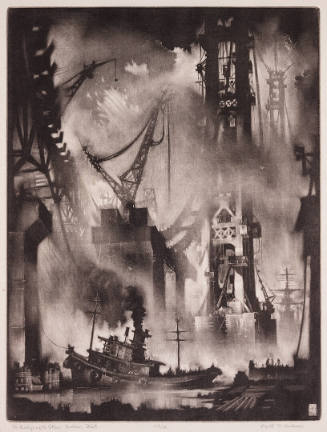
While the depicted time period is unclear, the subject of the work relates to the surge in shipbuilding before and during the Second World War.
Beal had recently painted a series of murals funded by the Treasury Section of Fine Arts—a product of Franklin D. Roosevelt’s New Deal. Painted in a similar style, Shipbuilding #1 focuses on working figures and celebrates regional history and industry. 7/16
Shipbuilding #1 relates to the surge in shipbuilding before and during World War II.
“Personally, I believe in a close association with the scene to be painted until it becomes a part of me through drawings and long observations. . . . When one has known a subject for a long time, when one is familiar with all its aspects, when one has sought for what makes it beautiful, what gives it movement—then it is time to paint it, because most of the problems have already been solved in the painter’s mind.” —Gifford Reynolds Beal
Construcción naval #1 hace referencia al auge de la construcción naval antes y durante la Segunda Guerra Mundial.
“Personalmente, creo en una estrecha relación con la escena que se va a pintar hasta que se convierte en parte de mí a través de dibujos y largas observaciones... Cuando uno conoce un tema desde hace mucho tiempo, cuando está familiarizado con todos sus aspectos, cuando ha buscado lo que lo hace bello, lo que le da movimiento, entonces es el momento de pintarlo, porque la mayoría de los problemas ya se han resuelto en la mente del pintor”. —Gifford Reynolds Beal 1/26