Indian Land #4
Indian Land #4
Artist
Fritz Scholder
(Luiseño, 1937 - 2005)
Date1980
MediumAcrylic on canvas
Dimensions80 × 68 in. (203.2 × 172.7 cm)
Framed: 82 3/8 × 70 3/8 × 2 1/4 in.
Framed: 82 3/8 × 70 3/8 × 2 1/4 in.
ClassificationsPainting
Credit LineCrystal Bridges Museum of American Art, Bentonville, Arkansas, 2018.1
Signedu.l.: Scholder
Accession number
2018.1
On View
On viewLabel Text“Most minorities have a homeland somewhere, a place that’s theirs. The Indian has a homeland that is possessed by another, dominant culture. This has, psychologically, very strange ramifications.”
—Fritz Scholder
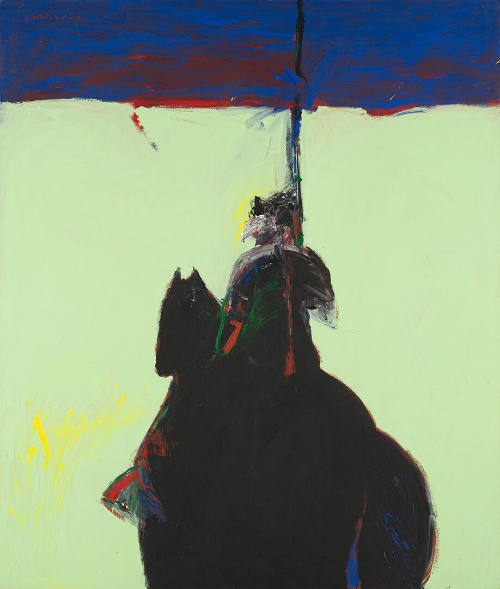
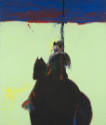
An abstracted figure mounted on horseback faces an apocalyptic sky. In his Indian Land series, Fritz Scholder expressed ongoing tensions among Native peoples regarding stolen land in America. His artwork revolutionized the way Native Americans are depicted in art as well as how American Indian artists are accepted in the contemporary art world. Scholder often confronted the felt or lived experiences of enduring settler colonialism portraying raw or painful experiences. Notice how the dark backgrounds and high horizon line keep the subject front and center.
“La mayoría de las minorías tienen una patria en algún lugar, un lugar que les pertenece. Los indígenas tienen una patria que está en manos de otra cultura dominante. Esto tiene, psicológicamente, consecuencias muy extrañas”. —Fritz Scholder
Una figura abstracta a caballo se enfrenta a un cielo apocalíptico. En su serie Tierras indias, Fritz Scholder expresó las tensiones continuas entre los pueblos indígenas con respecto a las tierras robadas en Estados Unidos. Su obra revolucionó la forma en que se representa a los indígenas estadounidenses en el arte, así como la forma en que los artistas indígenas estadounidenses son aceptados en el mundo del arte contemporáneo. Con frecuencia, Scholder se enfrentaba a las experiencias vividas o sentidas del colonialismo, retratando experiencias crudas o dolorosas. Observe cómo los fondos oscuros y la alta línea del horizonte mantienen al sujeto en primer plano y en el centro.
Inscribedverso, u.l., in black marker: Indian Land #3 - 1980